
When to Replace a Pickleball Paddle: 7 Signs It Is Done (2026)
Last updated: October 2026
Dead spots, core crush, cracks, a slick face and a paddle that suddenly plays hotter. How to check each one, and what to buy next.
Replace a paddle when it has a dead spot (a patch that sounds dull and returns less pace), visible cracks in the face or edge, a rattle inside, a face that stays smooth after cleaning, or when it suddenly plays much hotter than it did, which can mean the core or face has separated. A worn grip, a loose edge guard or a dirty face are fixable and are not reasons to replace on their own. There is no fixed lifespan: how often you play, how hard you hit and the face material all change it. If grit wear is what retires your paddles, pick a face with Tier 1 spin durability in independent lab testing, such as the Honolulu J6CR Crystal Blue ($175.50 with code PRH).
The rankings
Each category below links to the full review for that paddle.


Codes on the shop buttons above match our /deals table. Most of our partner brands use PRH (HEAD uses PRH15). The buttons open our affiliate link; paste the code at checkout if the brand asks for it.
Shop J6CR Crystal Blue… or J2CR Crystal Blue… with the live code
Each button is a tracked affiliate link at the sale price we list. Copy the code chip on the full review or use the code shown on the button label.
The seven signs
- 1. A dead spot. One area of the face sounds dull and the ball comes off slower. This is the classic sign of core crush, where the honeycomb or foam inside has compressed.
- 2. It suddenly plays hotter. More pop and less control than the same paddle had a few months ago can mean the face is separating from the core. Paddles that change like this can also fall outside the rules.
- 3. Cracks. Look along the face near the edge guard and at the throat where the handle meets the face. Any crack through the face is the end.
- 4. A rattle. Shake the paddle next to your ear. Anything loose inside means something has broken.
- 5. A slick face that cleaning does not fix. If the center still feels smooth after a proper clean, the grit has worn and your spin will not come back.
- 6. A bulge or soft spot. Press gently around the face with your thumb. A spot that flexes more than the rest is a warning.
- 7. The handle moves. A handle that twists or clicks against the face is a structural problem, not a grip problem.
How to test it at home in five minutes
- Tap test: hold the paddle loosely and tap a ball, or your knuckle, across the face in a grid. Listen for a patch that sounds flat compared with the rest.
- Bounce test: drop a ball from the same height onto different parts of the face held flat. A dead area sends it back noticeably lower.
- Light check: tilt the face under a light and look for hairline cracks and shiny worn patches.
- Feel check: run a dry fingertip across the sweet spot and then near the edge. If the center feels smoother than the rim, that is grit wear.
Fix it before you replace it
- Slippery handle: add an overgrip or a new grip. See how to regrip a pickleball paddle.
- Loose edge guard: if the face is fine, the guard can often be re-taped. Ask the brand first if the paddle is still under warranty.
- Dirty face: clean it properly before you judge the grit. See how to clean a pickleball paddle.
- Feels too light or too unstable: that is a tuning question, not a worn paddle. A few grams of lead tape can change it.
Check the warranty first
Most brands cover manufacturing defects for a set period and treat face wear as normal use. Core crush, delamination and cracks that appear without an impact are worth a warranty claim. Each of our reviews lists the warranty we have on record, so open the review for your paddle before you buy a new one.
For which current paddles hold up best inside, read the core crush audit.
Gear that helps
- Honolulu J6CR Crystal Blue: $195, $175.50 with code PRH. Gen 4.5 multi-density foam, Tier 1 spin durability in independent lab testing.
- Honolulu J2CR Crystal Blue: $195, $175.50 with code PRH. Same face on the hybrid shape, 7.0 twist weight.
- RPM Jade Elongated 16mm: $269.99, $229.49 with code PRH. SICmatrix silicon carbide face, Tier 1 spin durability.
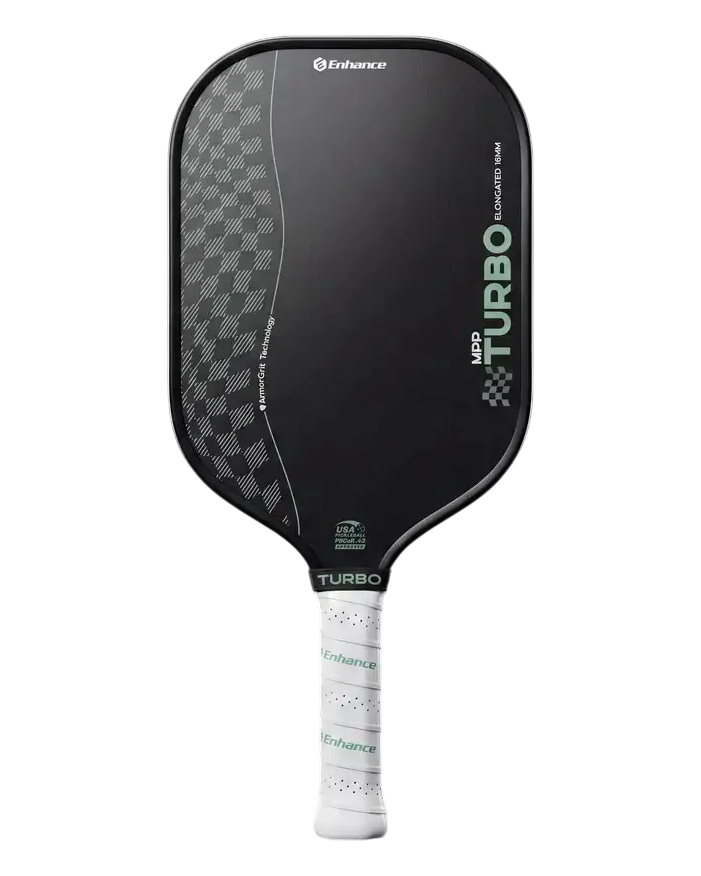
- Enhance MPP Turbo ArmorGrit Elongated: $119.99, $99.99 with code PRH. Full floating MPP foam with a durable ArmorGrit face.
- Hesacore Pickleball Original Grip: $26.90, $24.21 with code PRH10. If the only thing worn out is the handle.
Frequently Asked Questions
How long does a pickleball paddle last?
There is no fixed lifespan. Frequent players who hit hard wear out faces and cores faster. Replace it when you see a dead spot, cracks, a rattle, a face that stays slick after cleaning, or a sudden jump in power.
What is core crush?
Core crush is when the honeycomb or foam inside the paddle compresses in an area, leaving a dead spot that sounds dull and returns less pace.
Why does my paddle suddenly have more power?
A sudden jump in pop can mean the face has started to separate from the core. It is a reason to stop using the paddle and contact the brand.
Can I fix a dead spot?
No. A crushed core cannot be repaired. Check the warranty, then replace the paddle.
Should I replace my paddle when the grit wears off?
If you rely on spin, yes. Clean it first to be sure. Paddles with Tier 1 spin durability in independent lab testing, like the Honolulu Crystal Blue line ($175.50 with code PRH), lose the least spin.
Is a worn grip a reason to replace a paddle?
No. Replace the grip or add an overgrip. A Hesacore grip is $24.21 with code PRH10.
Related guides
Paste the code at checkout, then buy.
Brands on this page: Honolulu, Enhance. Codes are on each shop button and on /deals.